Marco Polo was born in Venice, Italy, around 1254. Venice was then the central of commerce in the Mediterranean and his father, Niccolo Polo, was a wealthy merchant.
When he was six years old, his father and uncle embarked on their first travel to China, then known as Cathay. He was raised by his aunt after the death of his mother. Marco Polo received education related to theology, trade, and shipping.
His father returned to Venice when he was 15 years old.
At the age of 17, Marco Polo traveled to Asia with his father and uncle Maffeo. They crossed 15,000 miles, traversing Persia, China, Japan and India.
The Polos traveled the western shores of the Caspian Sea until they made their way to the Persian Gulf. They passed through the Gobi Desert and, after three years of journey, they arrived at Shang-Tu, the original summer residence of the Mongol Emperor Kublai Khan.
Marco Polo’s father and uncle became friends with Kublai Khan during their stay in Bolghar. Kublai Khan was the fifth Great Khan of the Mongol Empire.
Marco Polo was loved by the emperor and asked him to serve at the Khan’s court. He vividly described his gratifying experiences in Cambaluc, Khan’s new summer residence (now Beijing) and official travels to Burma and India. Polo even recounted that it was the greatest palace he ever saw.
Specifically, he was amazed with China’s (Mongol Empire) complex social structure and power. Iron manufacture and salt production gave enormous wealth to the empire. In terms of transportation, canals were developed to connect the cities.
Paper money, porcelain bowls, and silk garments were all remarkable objects of China.
In 1277, Kublai Khan appointed Marco Polo as an official of the Privy Council and after three years he became the tax inspector in Yanzhou.
In 1295, the Polos decided to return home because Kublai Khan was already in his 70s and was seriously ill. Their last mission was to escort the Mongolian princess, Kokachin, to Persia.
During their homecoming, Venice was at war with Genoa. Marco Polo commanded a galley and was later captured at the Battle of Curzola. While in prison, he told his stories to Rustichello of Pisa, a writer and co-inmate. Rustichello documented every detail in the book called The Description of the World also known as The Travels of Marco Polo.
In 1299, after a year of imprisonment, Marco Polo returned to Venice, got married to a merchant’s daughter, and had 3 children.
Around 1300, Il Milione was published. It was divided into four volumes. Volume I depicted the territories in Central and West Asia. The second volume described China and the emperor’s court. The coastal regions of India, Japan, Sri Lanka, and Africa were recounted in volume III. Lastly, the wars of the Mongol Empire against territories up north were stated in volume IV.
His book became very popular and was translated into several languages during the middle ages because Europeans had little knowledge about the Far East.
Centuries after his death, explorers such as Henry the Navigator and Christopher Columbus were inspired by Marco Polo’s accounts. Columbus set sail to find new routes to the Orient.
The Polos were credited with trying to transport goods from Venice to China through the Silk Road. The Silk Road was the trading route connecting cities from Eastern Europe to China. The route got its name from silk cloth, which was the major export from China.
Marco Polo’s Death and Controversy
Despite Marco Polo’s popularity, his accounts became controversial because he never mentioned stories about the Great Wall of China and the Chinese practice of women foot binding, drinking tea, and writing in calligraphy. In addition, there were no accounts about Marco Polo’s visit in the Annals of the Empire known as Yuan Shih
Some historians speculate that much of Marco Polo’s accounts were fabricated by him. They believe that it was a product of Polo’s imagination and considered tales.
During the 18th and 19th centuries, travelers confirmed Polo’s accounts as they became an important resource for Chinese historians as they traced back the events during the siege of Xiangyang and attempted conquest of Japan.
On his deathbed, he remarked “I have only told the half of what I saw”. On January 8, 1324, Marco Polo died in Venice, Italy, and is said to be buried at the Church of San Lorenzo.
Vasco da Gama was now in his 20s and captain Bartolomeu Dias had returned from going around the Cape of Good Hope in 1488.
The king wanted an explorer to investigate the new African coastline and find a way to India and da Gama was the man for the job.
On 8 July 1497, da Gama set sail with a fleet of four ships and a crew of 170 men from Lisbon. The four ships were the São Gabriel, São Rafael, Berrio and an unnamed storage ship.
The journey around the southern tip of Africa to India and back again was long and dangerous. Despite having the most experienced navigators of the time on the voyage, two ships were lost and only 55 men survived.
The expedition at first followed the route established by early explorers past Tenerife, the Cape Verde Islands and Sierra Leone.
Da Gama then went south across the open ocean using the South Atlantic westerly winds that Bartolomeu Dias had discovered. Four months later, and having sailed more than 6000 miles of open ocean, the expedition made landfall in Southern Africa in November.
Come 16 December, da Gama’s expedition had reached the Great Fish River in the Eastern Cape of South Africa and then continued into unchartered waters.
Nearing Christmas, da Gama’s expedition arrived in an area they named Natal, meaning “the birth of Christ” in Portuguese.
By March of 1498, the voyage had reached Mozambique.
The region was Muslim and hostile to Christians, so da Gama impersonated being Muslim in order to speak with the Sultan and arrange trade. The meeting was unsuccessful, however, and da Gama and his crew fled to their ships and fired cannons to escape.
Da Gama again encountered hostility when reaching Mombasa in modern-day Kenya in April 1498 as he and his crew had resorted to piracy of unarmed Arab trading ships.
Continuing north, the expedition reached Malindi in Kenya and the first evidence of trade with India was observed. Da Gama commissioned a pilot with knowledge of the monsoon winds to guide the fleet of ships to Calicut, on the southwest coast of India. They departed for India on 24 April 1498.
The fleet finally arrived in Kappadu, near Calicut, on 20 May 1498. Da Gama was received with grand hospitality and he gave the king gifts of scarlet cloth, hats, coral, brass vessels, sugar, oil and honey. This did not impress the king who preferred gold and silver.
Come 29 August 1498, and with strained relations with Calicut the leadership, da Gama left for Portugal in October, ignoring warnings of the monsoon wind patterns. The journey across the Indian Ocean was treacherous and took 132 days to complete, rather than the 23 days it took to get to India. Many of his crew died of scurvy and there were only enough to man two ships.
The remaining vessels split up and the Berrio returned to Lisbon in July 1499. Da Gama had stayed back in Cape Verde because his brother was gravely ill.
When da Gama’s brother was well enough, they attempted to return to Portugal, but he died, so da Gama stopped in the Azores to bury him. After a time of grieving, he returned to Lisbon on 29 August 1499 where he was given a hero’s welcome.
LATER LIFE OF VASCO DA GAMA
Despite the mission failing in its original ambition of developing a spice trade for Portugal and the high death toll, da Gama is celebrated for finding a direct sea route to Asia.
Da Gama was rewarded with the town of Sines but because of competing Orders, was eventually forced to change from the Order of Santiago to the rival Order of Christ in 1507 to claim his reward.
Nevertheless, he still received substantial monetary reward from the crown and was given the title of Dom (lord). In 1502 he was awarded the title of Admiral of the Seas of Arabia, Persia, India and all the Orient.
Da Gama married Catarina de Ataíde in 1501 and had six sons and one daughter.
In 1502, he embarked on a follow-up expedition with the Fourth India Armada in order to take revenge on conflict with the previous India Armada. The Fourth Armada reached India with substantial amounts of gold by suppressing the island of Kilwa and from captured Arab vessels. Tragically, the Armada killed everyone on a pilgrim ship returning from Mecca.
The Portuguese fleet then bombarded Calicut after failed negotiations and news of da Gama’s violent treatment of people quickly spread but he failed to subdue the region.
After waging war in Calicut, da Gama returned to Portugal in 1503 where he lived quietly for nearly 20 years. In 1521, King John III took the throne and da Gama rose to become an advisor and eventually Viceroy.
He set out on his third voyage to India in April 1524 to India. He contracted malaria and died on 24 December 1524. He was buried first at St. Francis Church in Kochi, Portugal, then re-interred in Vidigueira in a casket decorated with gold and jewels.
Died: Killed by natives at the Hawaiian Islands on February 14, 1779
Best known for: Exploring the South Pacific
Biography:
James Cook was a British navigator and explorer who sailed and mapped much of the South Pacific.
Where did Captain Cook grow up?
James Cook was born on October 27, 1728 in Marton, England. His father was a farmer, but as James grew older he began to feel the lure of the sea. At around the age of 18 he took an apprenticeship as a merchant seaman. Although he did well and was advancing in the merchant navy, Cook decided to enlist in the Royal Navy at the start of the Seven Years War.
It was during the Seven Years War that James became a master at map making. His ability at surveying, navigating, and creating large accurate maps was noticed by those high up in the Navy.
The Endeavour
Cook was given command of the Endeavour by England's Royal Society. The ship was a cat-collier that was typically used for carrying coal. It wasn't fast, but it was durable and could carry a lot of supplies.
Captain Cook introduced some rigid and innovative rules in order to keep his crew healthy and safe. He required his men to bathe every day, the ship to be kept very clean, and the bedding to be aired twice a week. He also brought lots of fresh fruit to keep his men from getting scurvy. These rules and planning helped his men to stay healthy throughout the long voyages ahead.
First Expedition
Cook set off for his first journey on August 26, 1768. His main objective was to observe the planet Venus as it passed between the Earth and the Sun. This would help astronomers to calculate the distance of the Sun from the Earth. He also hoped to find the fabled southern continent.
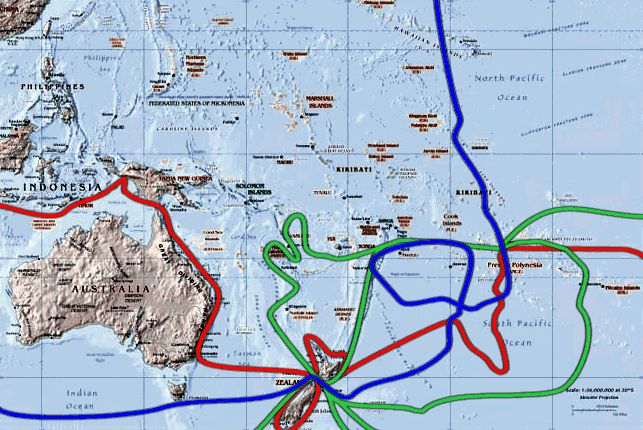
Routes of Captain James Cook through the South Pacific
The first voyage is in red, the second in green, and the third in blue.
By Andre Engels
Click to see a larger view
During this trip he visited Tahiti (where he made the observations of Venus), the Society Islands, and New Zealand. He mapped much of the two main islands of New Zealand, but also ended up fighting with the local Maori tribe.
Next stop on the journey was the east coast of Australia. Here James and his crew found all sorts of interesting animals and plants including the kangaroo. Unfortunately, the ship was damaged on some coral and they had to stop for a while to do repairs. Many of the crew got malaria from mosquitoes during this stop and over 30 of the crew died from the disease.
Finally they returned home in July of 1771, nearly three years after their departure.
Captain Cook's second expedition took place from 1772-1775. This time he took two ships, the Adventure and the Resolution. His goal was to either discover the southern continent or prove that it didn't exist. He went below 70 degrees latitude. This was the furthest south any European had explored. He also visited Easter Island.
Cook's final expedition lasted from 1776 to 1779. The goal of this journey was to find a northwest passage across North America to Asia. He searched the coast of Alaska to no avail. He did find the Hawaiian Islands, however (they were named the Sandwich Islands at the time).
At first Captain Cook and his men got along well with the natives of the Hawaiian Islands. However, things went bad when the natives stole a sailboat. Cook tried to kidnap the chief to hold him as ransom for the boat. In the attempt a fight broke out and he was killed by the natives.
Christopher Columbus was an Italian navigator and explorer whose voyages to the Americas led to the Spanish colonisation of the New World.
He was the first European to land on the South American mainland.
Top 10 facts
Columbusdid not discover the Americas. An estimated 100 million people were living there already, a number roughly equal to the population of Europe at that time. The first European to reach the North American coastline was the Norseman Leif Ericson who landed in Newfoundland c1000 AD.
People in Europe wanted to find a new route to the Indies, which was the name they gave to the Far East. Since the fall of Constantinople in 1453 the old Silk Route, along which silk, spices and other luxury items had been traded for centuries, had become difficult and costly to use.
Columbus hoped to find a new route east. He believed he could do this by sailing west. When he landed in the Americas he was convinced he was actually in the East Indies and so called the native people Indians.
Columbus approached the monarchs of Portugal, England, France and Spain seeking support for his plan. Finally Ferdinand and Isabella of Spain agreed to back his voyage of exploration.
Columbus left Palos in Spain on 3 August 1492 with ninety men and three small ships, the Nina, the Pinta and the Santa Maria. Their first stop was the Canary Islands where they collected supplies before settling out across the Atlantic on 6 September of the same year.
Land was first sighted on 11 October 1492 and on 12 October Columbus landed on an island in the Bahamas which he called San Salvador.
The second voyage on 24 September 1493 was made by 17 boats with 1200 men. The aim of the voyage was to colonise the new discoveries and convert the native people to Christianity.
Columbus made four voyages to the New World. He explored the Greater and Lesser Antilles, Venezuela and central America.
The native peoples of the Americas were treated very cruelly by Columbus and his men who exploited and enslaved them. Allegations of mismanagement on Hispaniola led to Columbus being returned to Spain in chains in 1500 and being stripped of his governorship.
It was Amerigo Vespucci who realised that a new continent had been discovered, so the Americas were named after him rather than Columbus.
Full name: Neil Alden Armstrong Date of birth: 5 August 1930 Hometown: Wapakoneta, Ohio, U.S.A. Occupation: Astronaut, military pilot, professor Died: 25 August 2012 Best known for: Being the first human to walk on the moon
1) Neil Armstrong was the first human to walk on the moon during the NASA (National Aeronautics and Space Administration) Apollo 11 mission on 20th July 1969. He completed the mission alongside co-pilots Edwin E. “Buzz” Aldrin and Michael Collins.
2) When Neil was a child growing up in rural America, he loved to learn all about aeroplanes and space. He got his student pilot’s licence when he was just 16 — before he even learned to drive a car!
3) When Neil was 17, he went to university to study aeronautical engineering — the science used in the designing, building and testing of aircrafts. Clever!
3) Around the world, more than half a billion people watched the Moon Landing. When Neil stepped foot on the moon for the first time, he said the now famous line, “That’s one small step for man, one giant leap for mankind.”
4) Neil walked a distance of about 60 metres on the surface of the moon —that’s roughly the length of 11 Asian elephants!
5) The rocket that launched Neil and his crew into space – the Saturn V rocket – was as tall as a 36-storey building! The Launch Control Center – which housed the team of people responsible for overseeing the launch from the ground – was situated 3.5 miles from the launch pad itself.
6) The Lunar Module that Neil and Buzz piloted together to land on the moon was called the Eagle. It’s where the now famous saying, “The Eagle has landed”, comes from!
7) Not only were Neil and Buzz the first humans to step foot on the moon, but they were also the first humans to view Earth from the moon’s surface. Neil said that while there, he could hold up his thumb and block out the Earth! He said that the Moon felt lonely, but that it made him realise just how beautiful our home is.
8) When Neil and his co-pilot, Buzz, were on the moon, they collected dust materials from the moon’s surface to study back on Earth. In 2017, the samples were sold at auction for £1.4 million — wow!
Welcome to our 6th Topic. VOYAGE OF DISCOVERY! Learning Objectives; 1. Find out who explorers are. 2. Explore why people explored.
The Age of Exploration
The Age of Exploration took place between the 15th and 17th centuries. During this time many countries in Europe sent out explorers to discover; 1. New lands, 2. Find trade routes, 3. Seek treasure, 4. Gain territory for their country. During this time much of the world was mapped and many world civilizations came into contact with each other. Sometimes it is called the Age of Discovery.
Why People Explore
The reasons for exploration can vary widely. Most explorers certainly like the adventure of going to a new place, meeting new peoples and cultures, or taking on new challenges.
Trade - Many countries and rulers funded explorers in order to find new trade partners and goods. In some cases they hope to find new trade routes that would help them to transport goods cheaper than their competitors. This was the case of Vasco da Gama and Christopher Columbus.
Gold - Often explorers have been in search of riches and treasure. They were primarily searching for gold and silver.
Science - In many cases, explorers are scientists hoping to learn about nature and new parts of the world. They may be hoping to find a new type of animal or type of plant. (new species of organisms)
Land - Many explorers claimed the land they found in the name of their country. Countries like Spain, Portugal, and Great Britain amassed huge empires during the Age of Exploration.
Challenge - Many explorers want to test their personal limits and be the first in the world to do something. These types of explorers include the men who raced to be the first to the North and South Poles, the top of Mount Everest, and to the Moon.
Upon completion of this lesson, students will be able to:
define collage
identify different methods of collage
compare the collages of various artists
construct a collage
What is Collage?
Collage is a form of artwork that is made by assembling different pieces to create a new, finished work of art. Collages can be made from a variety of materials such as paper and fabric.
There are so many different styles of collage.
Some collage can be abstract artwork while others make artwork that tells a story with people in different settings. There are also lots of different collage techniques. A technique is a way an artist puts together a work of art. This includes the materials used, the way they were glued together, and the way the pieces were cut.
A common way to make collages is by cutting out different objects from photographs and magazines to glue them together to make a finished scene.
Some artists also make collages by using several different materials. Collages can be made with paper, paint, string, and objects from nature like leaves, just to name a few. Some artists look for materials that were thrown away like cardboard and newspapers. Take a look at one of the collages Megan Coyle made by using different materials.